

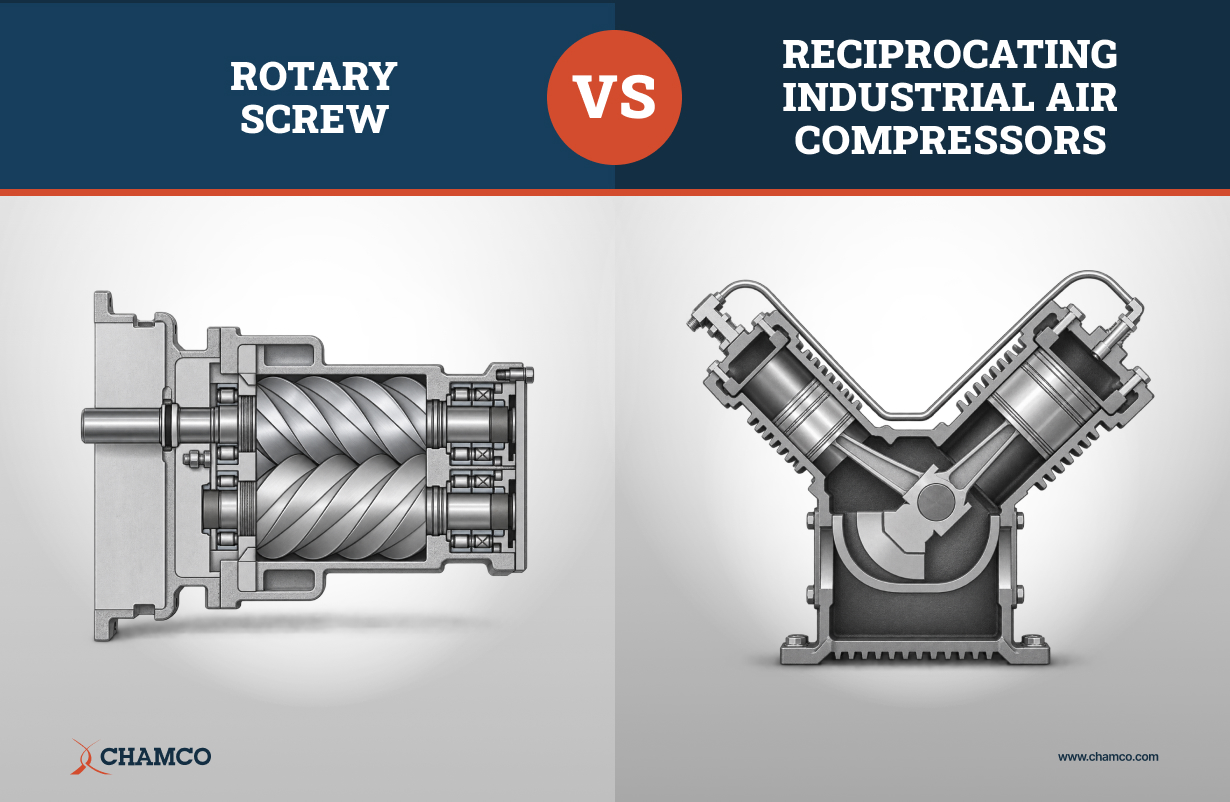
A rotary screw air compressor uses two meshing helical rotors to deliver a continuous stream of compressed air. A reciprocating compressor uses a piston moving up and down inside a cylinder to deliver air in pulses.
The rotary screw vs reciprocating industrial air compressor comparison usually starts with one question: how many hours a day does the compressor need to run? From there, the right choice also weighs maintenance capacity, noise tolerance, and expected asset life.
It isn’t about which technology is “better.” Reciprocating compressors suit intermittent duty and simple maintenance; rotary screw compressors suit continuous, heavy-duty operation.
TL;DR: Rotary Screw vs. Reciprocating Air Compressors
- Rotary screw compressors deliver continuous airflow and handle 24/7 duty; reciprocating compressors deliver pulsed airflow and suit intermittent, start-stop use.
- At full load, single-stage rotary screw compressors generally offer better specific power than comparable single-stage reciprocating units. However, high-efficiency, two-stage reciprocating compressors can outperform some rotary screw configurations. At partial load, compressor controls, air storage and operating patterns also influence energy efficiency.
- In Chamco’s experience, reciprocating compressors are most commonly used in smaller industrial applications, typically up to around 30 hp. Larger applications generally favour rotary screw compressors, although industrial reciprocating models are available at much higher horsepower ratings.
- For high-runtime operations approaching 8,000 hours annually, rotary screw compressors can offer lower total ownership costs. At around 1,000 operating hours annually, reciprocating compressors often offer a maintenance-cost advantage. Actual costs depend on equipment sizing, operating conditions and maintenance requirements.
- Rotary screw compressors are generally quieter than comparable reciprocating units, particularly when equipped with sound-dampening enclosures. Actual noise levels depend on the compressor’s size, configuration, and installation.
- Chamco supplies Sullair rotary screw compressors as well as Omega and Vanair screw/reciprocating compressors, sized to the application rather than sold as a default.
How Do the Two Technologies Differ?
A rotary screw compressor uses two meshing helical rotors to trap and compress air continuously, producing a steady discharge. A reciprocating compressor compresses air each time its piston completes a stroke, so the discharge pulses. This difference can affect downstream equipment. Reciprocating compressors may require an appropriately sized air receiver or pulsation dampener to reduce pressure fluctuations, while pressure relief valves provide protection against overpressure. There are 3 other important ways these technologies also differ:
- Cooling
- Lubrication
- Capacity
Cooling
Cooling plays an important role in compressed air quality and in protecting equipment. Many smaller reciprocating compressors rely on relatively simple cooling arrangements, while aftercoolers may be optional depending on the model. Discharge temperatures can exceed 200°F, leaving hot, moisture-laden compressed air entering the receiver.
As compressed air cools, water vapour condenses. Without adequate aftercooling, moisture separation, and drainage, this condensate can accumulate in downstream components, increasing the risk of corrosion. Properly specified cooling and moisture-removal equipment is therefore important regardless of compressor technology.
Lubrication
Lubrication requirements differ between compressor designs. Many lubricated reciprocating compressors use conventional compressor oils, while premium rotary screw compressors commonly use synthetic fluids such as polyalphaolefin (PAO) or polyglycol formulations.
Lubricant selection affects thermal stability, oxidation resistance and deposit formation. In reciprocating compressors, wear of piston rings and other sealing components can also increase oil carryover and reduce compression efficiency over time.
Oil carryover is not determined by compressor technology alone. Equipment condition, lubricant selection, operating conditions and downstream filtration all affect the quality of delivered compressed air.
Capacity
Capacity is another important consideration. In Chamco’s experience, reciprocating compressors are most commonly used in smaller industrial applications, typically up to around 30 hp. Larger, continuous-duty applications generally favour rotary screw compressors.
However, reciprocating technology is not limited to small compressors. Larger single-acting and double-acting industrial reciprocating machines are available, including configurations rated at hundreds of horsepower.
Historically, large reciprocating compressors were common in industrial facilities such as sawmills. Many of these applications have since transitioned to rotary screw technology to support continuous operation, consistent airflow and demanding production schedules.
Which Compressor Is More Efficient?
Efficiency depends on compressor configuration, operating pressure, capacity and loading conditions. Rotary screw compressors often provide an efficiency advantage over comparable single-stage reciprocating units, particularly in continuous-duty applications. However, larger two-stage reciprocating compressors can achieve competitive, or even lower, specific power under certain operating conditions.
| Compressor Type | Specific Power (kW/100 cfm @ 100 psig) |
| Single-stage reciprocating | ~24 |
| Two-stage reciprocating (single-acting) | ~19–21 |
| Two-stage reciprocating (double-acting) | ~15–16 |
| Single-stage rotary screw | ~18–19 |
| Two-stage rotary screw | ~16–18 |
These figures demonstrate why compressor efficiency should be evaluated by configuration rather than technology alone. Full-load efficiency is also only part of the equation. When air demand fluctuates, unloaded power consumption, compressor controls and available air storage can significantly affect overall energy use.
Reciprocating compressors can be particularly economical in intermittent applications because they can stop when sufficient air has been stored and restart as pressure falls. Rotary screw compressors are generally better suited to sustained demand, although properly sized variable-speed or appropriately controlled units can also accommodate fluctuating loads.
Control strategy moves the number as much as the compressor type does. Natural Resources Canada’s own modelling for a 100 hp compressor, 65% average load, 4,250 annual operating hours and electricity priced at $0.10/kWh shows an annual energy cost of $33,240 under basic load/unload control, $27,820 with added air storage, and $23,480 with a variable-speed drive. Control strategy can matter as much as the base technology.
What Duty Cycle Fits Your Operation?
Duty cycle is one of the most important factors when selecting an industrial air compressor. Many smaller, air-cooled reciprocating compressors are designed for intermittent operation, with duty-cycle ratings ranging from approximately 50% to 75%, depending on the model. Other industrial reciprocating compressors are specifically engineered for continuous duty.
Rotary screw compressors are generally designed to accommodate sustained, high-demand operation, making them a common choice for multi-shift production facilities. Based on Chamco’s experience, the following operating patterns provide useful starting points:
- Around 8,000 operating hours annually: A properly sized rotary screw compressor will often provide a lower total cost of ownership in continuous-duty applications.
- Around 1,000 operating hours annually: A reciprocating compressor may offer lower maintenance and ownership costs when air demand is intermittent.
These are general application guidelines rather than fixed economic thresholds. Actual operating costs depend on compressor capacity, loading patterns, electricity rates, maintenance requirements and equipment selection.
Pushing either technology outside its duty cycle causes problems. A rotary screw forced to short-cycle shows more breakdowns and oil carryover than a properly loaded unit. A reciprocating compressor pushed to run eight continuous hours risks overheating if it wasn’t specified for that duty. A premium, pressure-lubricated reciprocating compressor can be built for 100% duty, but the added componentry required pushes its price close to that of a comparable rotary screw unit anyway.
How Loud Is Each Compressor Type?
Rotary screw compressors are generally quieter than comparable reciprocating compressors, particularly when equipped with sound-dampening enclosures. Many reciprocating compressors are supplied without acoustic cabinets, although enclosed and low-noise models are available.
Noise levels vary considerably by equipment size, configuration and installation. Facilities should compare the manufacturer’s sound-level specifications under equivalent measurement conditions when evaluating the potential impact on their workplace.
For general reference, air compressors measured at 3 feet typically fall between 80 and 86 dBA for smaller units (under 5 hp) and 85 and 92 dBA for mid-size units up to 100 hp, per standard mechanical-equipment noise data from CED Engineering. These are general benchmarks, not figures split by design, but a reminder that noise is worth planning around. The practical fix is a cabinet or placing the unit in a separate room.
For a Canadian benchmark, WorkSafeBC’s OHS Regulation sets a daily noise exposure limit of 85 dBA (Lex) for BC workplaces, with an 82 dBA threshold that triggers a duty to measure exposure. A compressor’s published sound level does not necessarily represent an employee’s daily noise exposure. Actual exposure depends on factors such as operating duration, distance from the equipment and other workplace noise sources.
What’s the True Cost of Ownership?
Capital and Maintenance Costs
Smaller reciprocating compressors generally have lower initial purchase costs than comparable rotary screw units. Facilities with relatively low annual operating hours can also offer a maintenance-cost advantage.
This difference narrows when comparing premium, continuous-duty reciprocating compressors with similarly sized rotary screw equipment. Total ownership costs should account for purchase price, electricity consumption, maintenance, expected operating hours and equipment lifespan.
Operating Costs
According to Natural Resources Canada, over a 10-year lifespan for a typical air-cooled compressor on two shifts, roughly 88% of total ownership cost is operating expense, and electricity alone accounts for about 76% of lifetime cost.
Leaks make that worse. Facilities typically lose 20 to 30% of their output to leaks, but proactive management can bring that down to under 10%. At $0.10/kWh, a quarter-inch leak costs roughly $3,210 a year, and a half-inch leak about $12,820 a year. A leak-management program has the potential to do more for the bill than the choice between technologies.
Right Sizing
Right-sizing can matter more than compressor type. One Chamco customer had a 40-hp rotary screw compressor sized for a crane, used roughly once a year. Chamco replaced it with smaller reciprocating compressors matched to actual daily demand, with a rented portable unit covering the rare days the crane runs. The result was approximately $4,000 a year in annual operational savings, with the full project reaching ROI in roughly five years.
How Do Maintenance Needs Compare?
Reciprocating compressors, particularly smaller industrial models, often have relatively straightforward maintenance requirements. Depending on the manufacturer’s specifications, routine maintenance may include:
- Checking lubricant levels and inspecting for leaks.
- Inspecting and maintaining pressure relief devices.
- Checking belt condition and tension.
- Changing lubricants and replacing air filters.
- Inspecting valves, piston rings and other wear components.
Maintenance intervals vary by equipment model, operating conditions and accumulated operating hours. Always follow the manufacturer’s recommended service schedule.
Rotary screw compressors require less frequent attention overall, but the maintenance they need (fluid changes, filtration, internal inspection) is more specialized and typically calls for a qualified technician.
| Factor | Reciprocating | Rotary Screw |
| Frequency | Interval-based: daily, weekly, monthly, quarterly, annual | Less frequent, with longer intervals between services |
| Typical tasks | Lubricant and leak checks, relief-valve tests, cooler cleaning, belt tension, oil changes, valve inspection | Fluid changes, filtration replacement, and internal inspection |
| Who can perform it | Simple enough to handle without a maintenance contract | More specialized; typically needs a qualified technician |
Chamco’s troubleshooting guide covers common failure symptoms across both technologies, and customers without in-house maintenance staff have the option to use Chamco’s preventative maintenance program.
Can You Use Both Rotary Screw and Reciprocating Compressors in One System?
Many industrial facilities benefit from operating multiple compressors to accommodate different demand profiles. Depending on the application, this may involve combining rotary screw and reciprocating compressors or using multiple rotary screw units of different capacities.
For example, a food and beverage facility might rely on a rotary screw compressor during its primary production shifts, then switch to a smaller reciprocating compressor during overnight cleaning or lighter weekend operations. Appropriate filtration, storage and system controls help maintain the required compressed air quality across both operating modes.
A sawmill might use a 300 hp rotary screw compressor during full production and a smaller 100–200 hp unit during reduced-production weekend shifts. This avoids operating the larger compressor inefficiently when air demand is substantially lower.
In either case, the objective is to match available compressor capacity to actual demand. Proper sequencing and equipment sizing can reduce unnecessary energy consumption and equipment wear.
Which Compressor Should You Choose?
Three questions settle most of these decisions before a vendor gets involved:
- How many hours a day does your operation actually need compressed air? Intermittent demand for a few hours daily may favour a reciprocating compressor, while sustained, multi-shift operation generally favours rotary screw technology. The compressor’s actual loading pattern is just as important as its total operating hours.
- Is there in-house staff or a maintenance contract in place? If not, the simpler reciprocating compressor is usually the easier fit, especially at a remote site.
- How long does this asset actually need to last? Equipment needed for a five-year project doesn’t need to be built to run for twenty.
The most common mistake is applying the wrong compressor to the job and sizing equipment around the original request rather than the actual runtime, duty cycle, and maintenance capacity. A rotary screw compressor, forced into light, intermittent use and short cycles, wears out early; a reciprocating compressor, pushed into continuous duty, overheats and needs premature rebuilds. Most customers make this decision every 5 to 20 years without benchmark data to know what’s typical, which is why these three questions matter more than brand or price. See Chamco’s guide for more tips on choosing the right compressor.
Get Expert Guidance from Chamco
Choosing the right industrial air compressor starts with understanding how your facility actually uses compressed air. At Chamco, our consultative approach considers operating hours, air demand, maintenance resources, equipment lifespan and total ownership costs before recommending a solution. That sometimes means recommending a reciprocating compressor when a customer initially requests a rotary screw unit. In other cases, a rotary screw compressor or a combination of technologies may provide better long-term value.
Chamco supplies both technologies as the exclusive Western Canada distributor of Sullair rotary screw compressors and the Omega and Vanair reciprocating compressor lines, and handles installation once the right unit is chosen. A Chamco discovery conversation walks through actual runtime, maintenance resources, and project timeline before recommending either technology. Contact us to assess the right compressor for your application.