

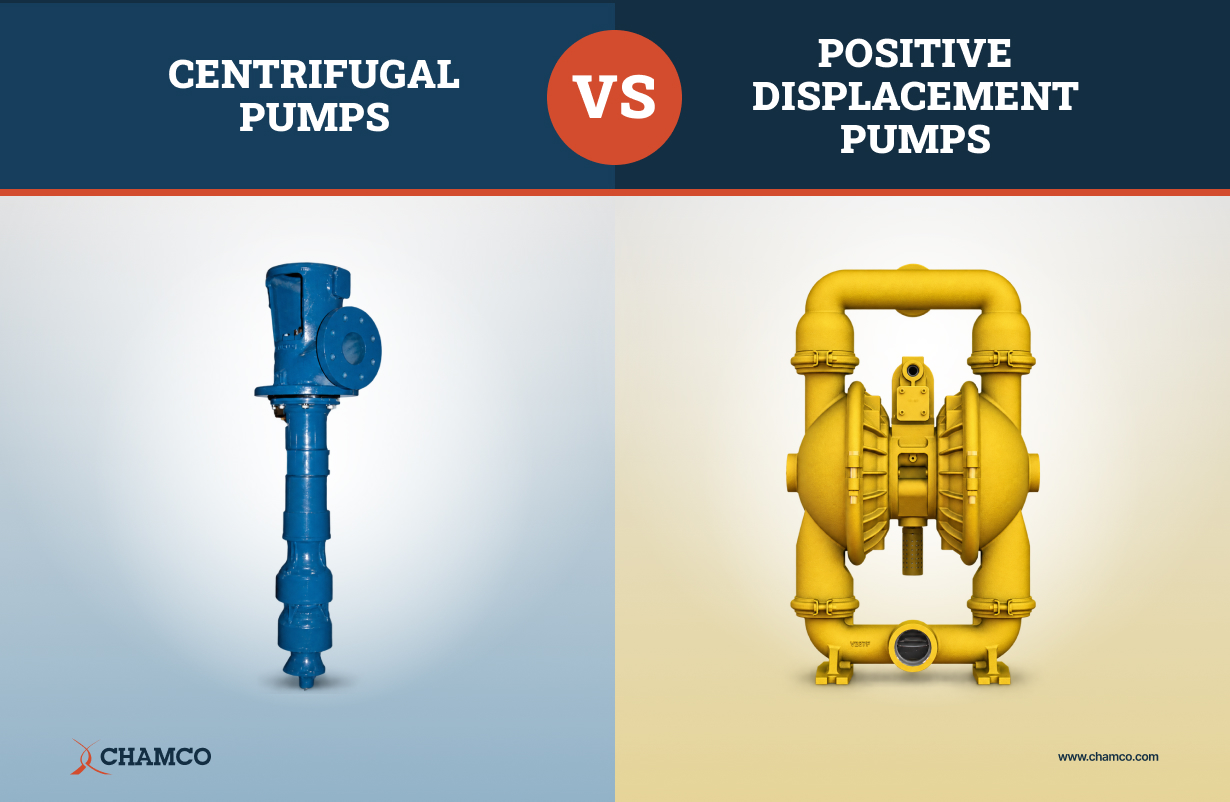
A centrifugal pump uses a spinning impeller to accelerate liquid, then converts that velocity into pressure as the liquid leaves the pump casing. A positive displacement (PD) pump traps a fixed volume of liquid in a chamber and physically pushes that volume through the system, with each rotation or stroke of its mechanism. That single structural difference explains almost everything else that separates centrifugal and positive displacement pumps, from how efficiency behaves to which fluids each one can handle to how you read their performance curves.
Chamco sells and services both types of pumps across water, wastewater, oil and gas, and industrial process applications, and the two often appear together in the same system more than most people expect. This breaks down where centrifugal and positive displacement pumps diverge and where a plant actually needs both.
TL;DR: Centrifugal vs Positive Displacement Pumps
- Centrifugal pumps use a rotating impeller to convert velocity into pressure.
- Positive displacement pumps trap and push a fixed volume of liquid each cycle.
- Centrifugal efficiency peaks at one flow rate, the Best Efficiency Point (BEP), and then falls off on either side; positive displacement pumps can maintain relatively consistent flow over a wide pressure range, although efficiency varies with pump type and operating conditions.
- Centrifugal pumps suit low-viscosity fluids and flows that can vary with pressure.
- Positive displacement pumps suit high-viscosity fluids and duties that need constant, precise flow.
- Many systems use both pump types together, each handling a different job in the same process.
- Centrifugal pumps generally cost less to maintain.
- Positive displacement pumps have more wear parts but stay accurate under difficult conditions.
| Characteristic | Centrifugal | Positive displacement |
| Peak efficiency | Very high when properly selected | High |
| Efficiency across flow range | Drops away from BEP | Relatively consistent |
| High-pressure, low-flow duty | Often less efficient | Usually advantageous |
| High-flow, moderate-head duty | Usually advantageous | Often less practical |
| High-viscosity liquids | Efficiency can deteriorate significantly | Often advantageous |
| Low-viscosity liquids | Excellent application | Internal slip can reduce PD efficiency |
| Effect of increasing discharge pressure | Flow changes substantially | Flow changes relatively little |
| Part-load operation | Can become inefficient | Generally maintains efficiency better |
How Do Centrifugal Pumps Work?
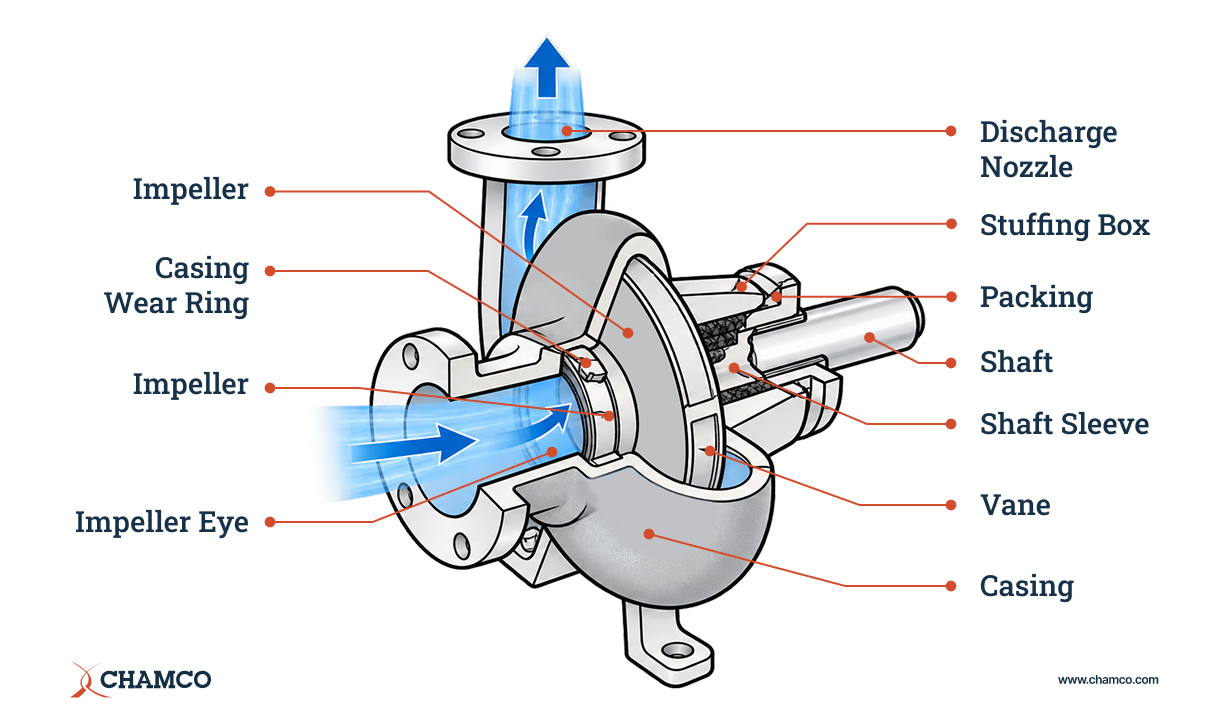
A centrifugal pump moves liquid with a rotating impeller mounted inside a casing. As the impeller spins, it flings liquid outward, converting the motor’s rotational energy into the liquid’s velocity. The casing then slows the liquid in a controlled way through a volute or diffuser, and that deceleration converts velocity into pressure. Nothing traps or displaces a fixed volume of liquid. A centrifugal pump is a dynamic, velocity-based machine, not a metering device. Vertical turbine pumps use this principle for municipal and industrial water handling, building head by staging multiple impellers rather than relying on one.
Every centrifugal pump has one flow rate at which it runs most efficiently, called the Best Efficiency Point (BEP). At BEP, the impeller design, casing geometry, and flow path work together to minimize internal losses. Move away from that point in either direction, whether throttled back or pushed past it, and efficiency drops because the liquid is no longer travelling through the casing as the impeller and volute were designed for.
What Is a Positive Displacement Pump?
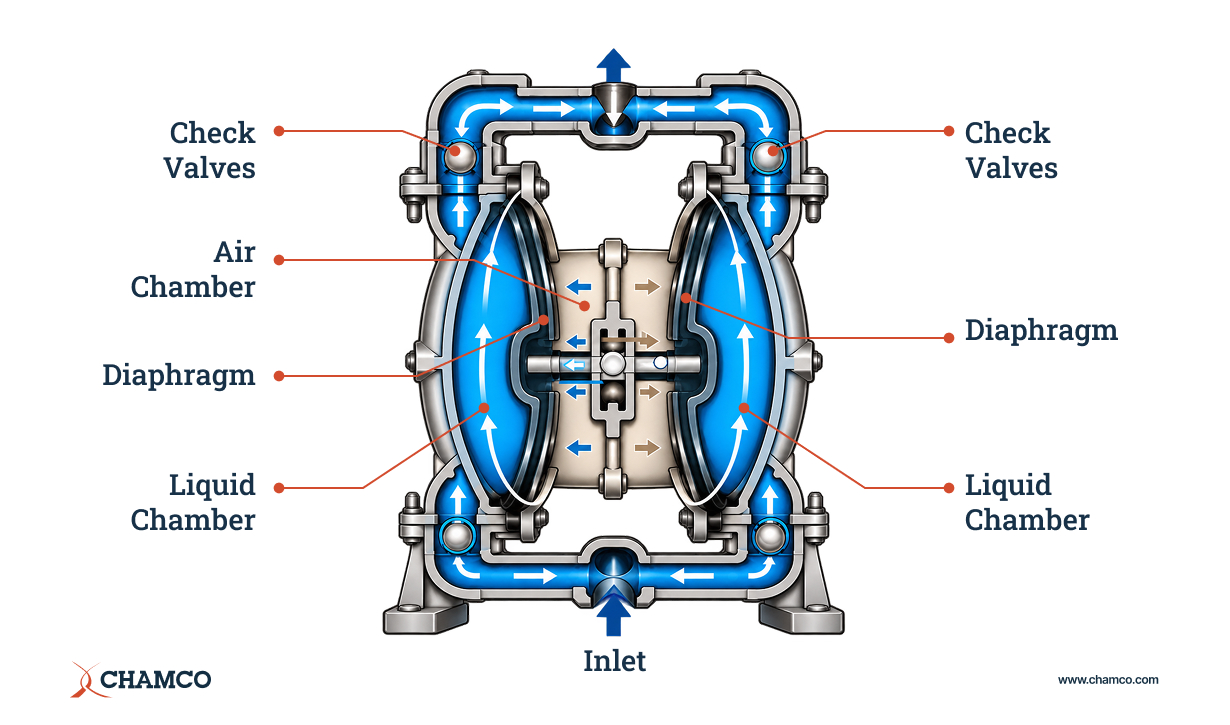
A positive displacement pump moves liquid by trapping a fixed volume in a chamber, sealing it off from the inlet, and mechanically pushing that volume out through the discharge. Diaphragms, screws, gears, and pistons are all different mechanical ways of creating and moving that sealed volume, but the underlying principle is the same: displacement, not velocity.
Air-operated double diaphragm (AODD) pumps are a common PD design where compressed air drives a diaphragm back and forth, opening and closing a set of check valves that trap and release liquid on each stroke. Because output is tied to how many strokes or rotations happen per minute rather than to a spinning impeller’s velocity, a PD pump’s flow rate follows its drive speed far more directly than a centrifugal pump’s does.
Which Pump Type Is More Efficient?
Centrifugal pumps can reach higher peak efficiency than most positive displacement pumps, but only within a narrow band around their BEP.
A Peerless 18HXB/HC vertical turbine pump built for a Chamco water-reclaim application shows this clearly. At its rated duty point, the pump runs at 82.51% bowl efficiency and 81.65% pump efficiency, nearly at BEP, with a flow ratio of 97.15%. Move off that point, and efficiency steps down on both sides of the curve, from 82% through 81%, 78%, and 72%, down to 64% and 55%, even though nothing about the pump itself changed.
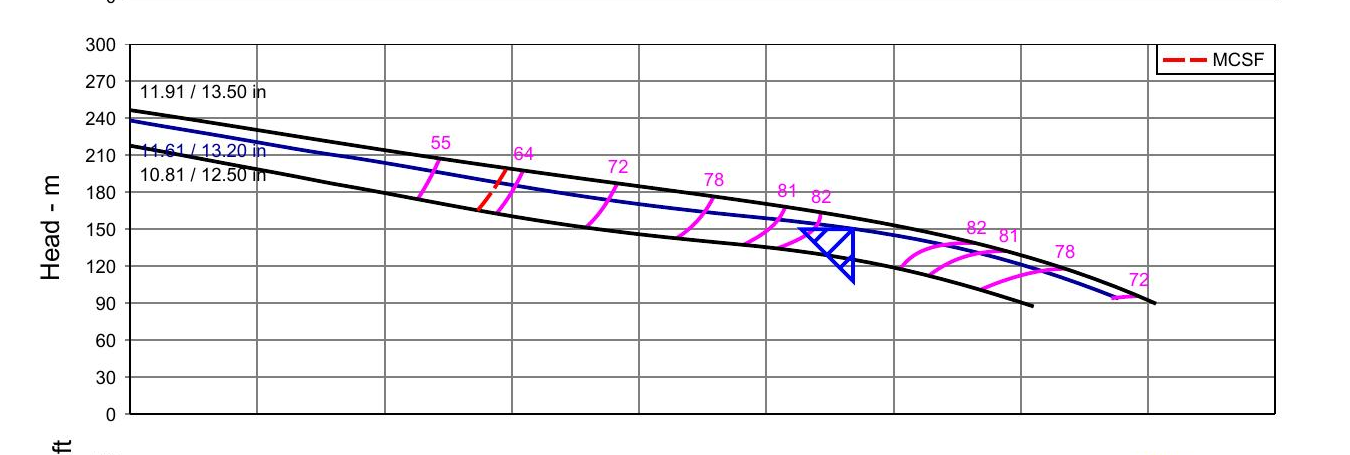
A Peerless 18HXB/HC vertical turbine pump curve: efficiency percentages step down on both sides of the best efficiency point.
Positive displacement pumps don’t have that single peak. As a centrifugal pump is operated away from BEP, efficiency decreases, whereas a positive displacement pump maintains relatively consistent performance across varying pressure conditions rather than tailing off on either side. Centrifugal pumps are also typically recommended to run within roughly 70 to 115 percent of BEP flow; push them further outside that band, and energy use per unit of capacity climbs, along with vibration.
That efficiency gap has real financial weight behind it. Industrial energy systems, the category that includes pumps alongside process heating, compressed air, and other motor-driven equipment, account for roughly 80% of the energy Canadian industry uses, according to Natural Resources Canada. The Hydraulic Institute reports that energy alone accounts for about 40% of a pump’s total cost of ownership over a 15- to 20-year lifespan, more than the purchase price and maintenance combined. A pump running consistently away from its efficient range carries that energy loss for the life of the equipment.
What Fluid and Pressure Conditions Favour Each Pump?
Two factors determine which pump is best for a given application:
- the fluid’s viscosity
- how the required flow behaves under pressure
Engineers generally treat a liquid as viscous above roughly 40 centipoise, and the use of centrifugal pumps above about 300 centistokes is generally not recommended because pump efficiency becomes poor at that point. Push a centrifugal pump into fluids above roughly 1,400 centistokes, and it becomes an extremely inefficient way to move liquid. Positive displacement pumps don’t have that ceiling, which is why they handle wastewater sludge, oils, and other thick or difficult fluids that would stall a centrifugal design.
The second factor is how flow behaves under pressure. A centrifugal pump’s flow-pressure trade-off is that higher pressures are achieved only at lower flow rates because flow depends on system pressure. Positive displacement pumps deliver a relatively consistent flow at a given speed, with actual flow affected by pressure, internal slip, viscosity, and pump condition. They are constant-flow machines whose output is controlled by adjusting pump speed rather than by downstream pressure. That predictability is why PD pumps are the standard choice for chemical dosing, metering, and injection duties, where flow has to hold steady no matter what the system pressure is doing.
Put together, a comparison of centrifugal vs positive displacement pumps usually comes down to one practical question. Does the application need raw flow or precision? Chamco’s guide to choosing the right industrial pump covers the broader selection process beyond pump type alone.
Can One System Use Both Pump Types?
Yes, and in many industrial systems, that is the normal setup rather than the exception. Many plants intentionally use a centrifugal pump for bulk liquid movement and a positive displacement pump for a second job in the same process that needs precise flow, high pressure, high viscosity, or controlled dosing.
| System | Centrifugal Pump Role | PD Pump Role |
|---|---|---|
| Oil and gas
(Steam-Assisted Gravity Drainage) |
Bulk-produced water transfer | Thick bitumen lifts past the centrifugal’s viscosity limit |
| Water treatment | Main process or transfer water | Chemical dosing |
| Boiler system | Feedwater or circulation | Chemical treatment injection |
| Mining | Water/slurry transfer | Reagent dosing or viscous chemical transfer |
| Food processing | Water/CIP circulation | Syrup, concentrate, oil, or viscous product |
| Wastewater | Plant/process pumping | Polymer or chemical dosing |
| Industrial lubrication | Cooling/process-water circulation | Lubricating oil delivery |
| Dewatering | Large-volume water removal | Chemical treatment or specialized sludge handling (adding chemical to process) |
In each case, the centrifugal pump handles the volume, and the positive displacement pump handles the accuracy. Because the two pump types interact with a piping system differently, pumps are rarely swapped for one another once a system is running; a change usually only happens if reliability becomes an issue with the installed pump or the process itself changes. Chamco’s installation team designs these combined systems from the start rather than retrofitting a second pump type in after the fact.
How Do Maintenance Costs and Lifespan Compare?
Centrifugal pumps generally need less maintenance. They rely on fewer wear components (mechanical seals, bearings, wear rings, and the impeller) and, in the right application, can be very long-lived. Positive displacement pumps add more wear parts (seals and bearings, plus technology-specific components like diaphragms or check valves), so routine maintenance costs are higher, especially for abrasive or difficult fluids.
| Maintenance Factor | Centrifugal | Positive Displacement |
| Main wear components | Mechanical seals, bearings, wear rings, and impeller | Seals and bearings, plus technology-specific components |
| Routine maintenance | Generally lower | Generally higher |
| Number of wearing components | Usually fewer | Often more |
| Sensitivity to abrasive solids | Depends heavily on design | Depends heavily on PD technology |
| Sensitivity to running off-design | High | Generally lower hydraulically |
| Dry-running tolerance | Usually poor | Varies significantly |
| Rebuild complexity | Often relatively straightforward | Can be more specialized |
| Expected service life | 20+ years is very achievable | 20+ years achievable, but wear parts are replaced more often |
| Maintenance predictability | High in stable applications | Often high because wear parts can be scheduled |
Both pump types can reach 20 or more years of service life in the right application. The difference shows up in what maintenance looks like along the way: a well-selected centrifugal pump can run for years on predictable, scheduled service, while a positive displacement pump handling abrasive or difficult fluids may need wear components replaced more often, even when the pump itself lasts just as long. See Chamco’s pump maintenance checklist for the routine inspection points that keep either type running on schedule.
That maintenance gap plays out against a bigger number: maintenance makes up roughly 25% of a pump’s total cost of ownership over its lifespan, energy makes up about 40%, and the purchase price itself is only around 10% (Hydraulic Institute). Matching pump type to the application, rather than choosing on price alone, is what keeps that 25% from growing.
How Do You Read Each Pump’s Performance Curve?
A centrifugal pump curve plots flow on the horizontal axis against head (or pressure) on the vertical axis at a fixed pump speed. Efficiency is layered on top as a set of curved contour lines, each marking a percentage, that step down the further the operating point sits from BEP.
A positive displacement pump curve reads differently because the output is not tied to a single variable. An air-operated diaphragm pump curve, for example, plots discharge flow against discharge head for a family of lines representing air supply (in SCFM) and air pressure (in PSI), since both control how fast the diaphragm cycles.
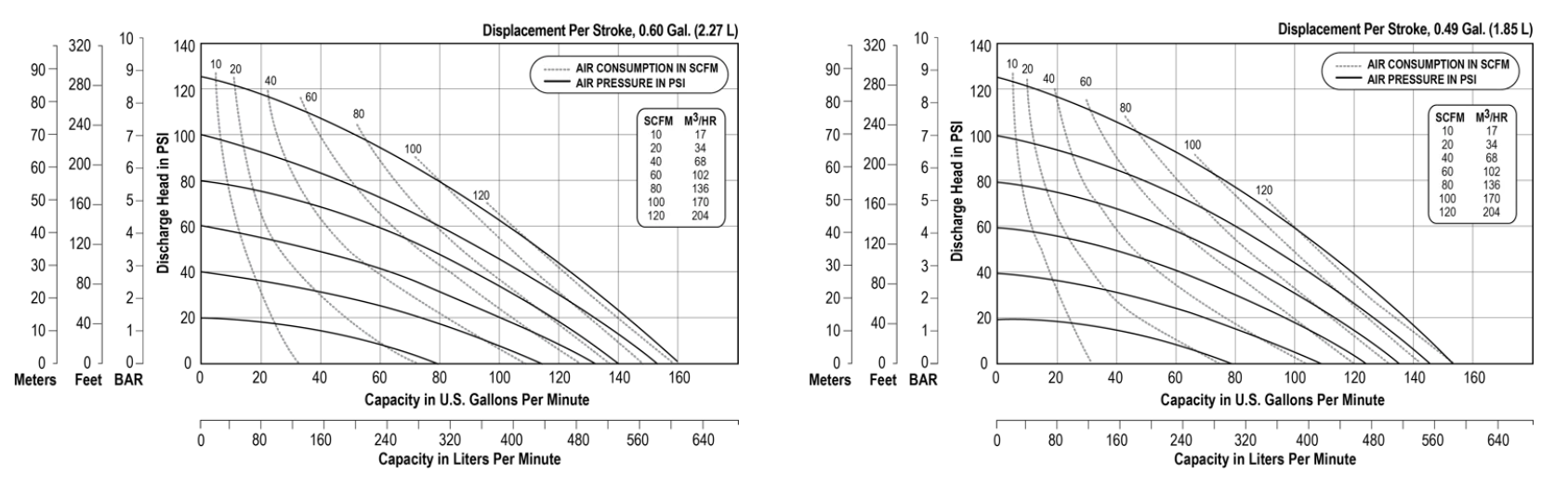
Versamatic-style air-operated diaphragm pump curves: discharge flow plotted against head for a range of air supply (SCFM) and air pressure (PSI) inputs, 0.60 gal and 0.49 gal displacement models.
Reading one means finding the intersection of two inputs rather than following a single line. At 100 PSI and 80 CFM, for example, an air-operated diaphragm pump like the Versamatic models Chamco distributes delivers roughly 320 L/min. Neither curve is hard to read once you know what it’s showing, but they answer different questions. A centrifugal curve shows how far you are from peak efficiency at a given flow. A positive displacement curve shows the air, hydraulic, or electrical input required to reach a target flow rate.
Which Pump Fits Your Project?
Centrifugal pumps work best for lower-viscosity fluids where flow can vary with pressure and duty cycles run continuously, while positive displacement pumps work best for viscous fluids, precise dosing, and situations where flow needs to hold steady no matter what the pressure is doing. Many systems need both, each doing a different job in the same process, and because the two designs interact with piping differently, they are not something to swap after the fact if the original selection was wrong.
Getting that selection right up front is what Chamco’s team does, whether that means specifying a single pump or designing a system that pairs a centrifugal pump with a positive displacement pump. If you are working through a pump selection for a new or upgraded system, contact Chamco to discuss the application with an engineer, or explore Chamco’s industrial pump lineup to see the available centrifugal and positive displacement options.