


A pump performance curve is used to determine which pump actually fits a given system or application. The curve shows how much flow and head a specific pump can deliver at a given speed, plotted on the same sheet as its efficiency, power, and net positive suction head (NPSH) data.
Selecting a pump without reading that chart correctly can lead to choosing a pump that runs inefficiently, cavitates, or simply can’t hit the pressure and flow a system actually needs.
This guide covers what’s plotted on a typical pump curve, how to find your duty point on a real manufacturer’s selection sheet, what affinity laws and NPSH mean, and why they matter.
TL;DR
- A pump curve plots flow against head, plus efficiency, power, and NPSH on the same sheet.
- Your duty point is the exact flow and head your system needs, usually marked directly on a manufacturer’s selection printout.
- Affinity laws explain why changing pump speed or impeller diameter shifts the entire curve, not just a single point on it.
- The most common selection mistake is choosing a pump whose required NPSH exceeds the NPSH actually available in your system.
- Most manufacturers including Peerless, Grundfos and Cornell use similarly formatted selection sheets..
What’s Actually Plotted on a Pump Curve?
At the centre of a pump curve is the QH curve, which shows flow (Q) plotted against head (H) to determine the pressure the pump adds to the system. As flow increases, head decreases, and vice versa.
Other curves can be layered on the same sheet to describe the rest of the pump’s behaviour, including:
- An efficiency curve showing how much input power turns into useful pumping work
- A power curve showing the horsepower the motor draws at each flow rate
- An NPSH curve showing the suction conditions the pump needs to avoid cavitation
Impeller diameter, or trim, shows up here too. A smaller trim shifts the whole QH curve down, similar to what happens when you reduce pump speed.
How Do You Find Your Duty Point?
The duty point is the flow and head your system actually needs the pump to produce, and on a manufacturer’s selection printout, it’s usually marked directly on the curve.
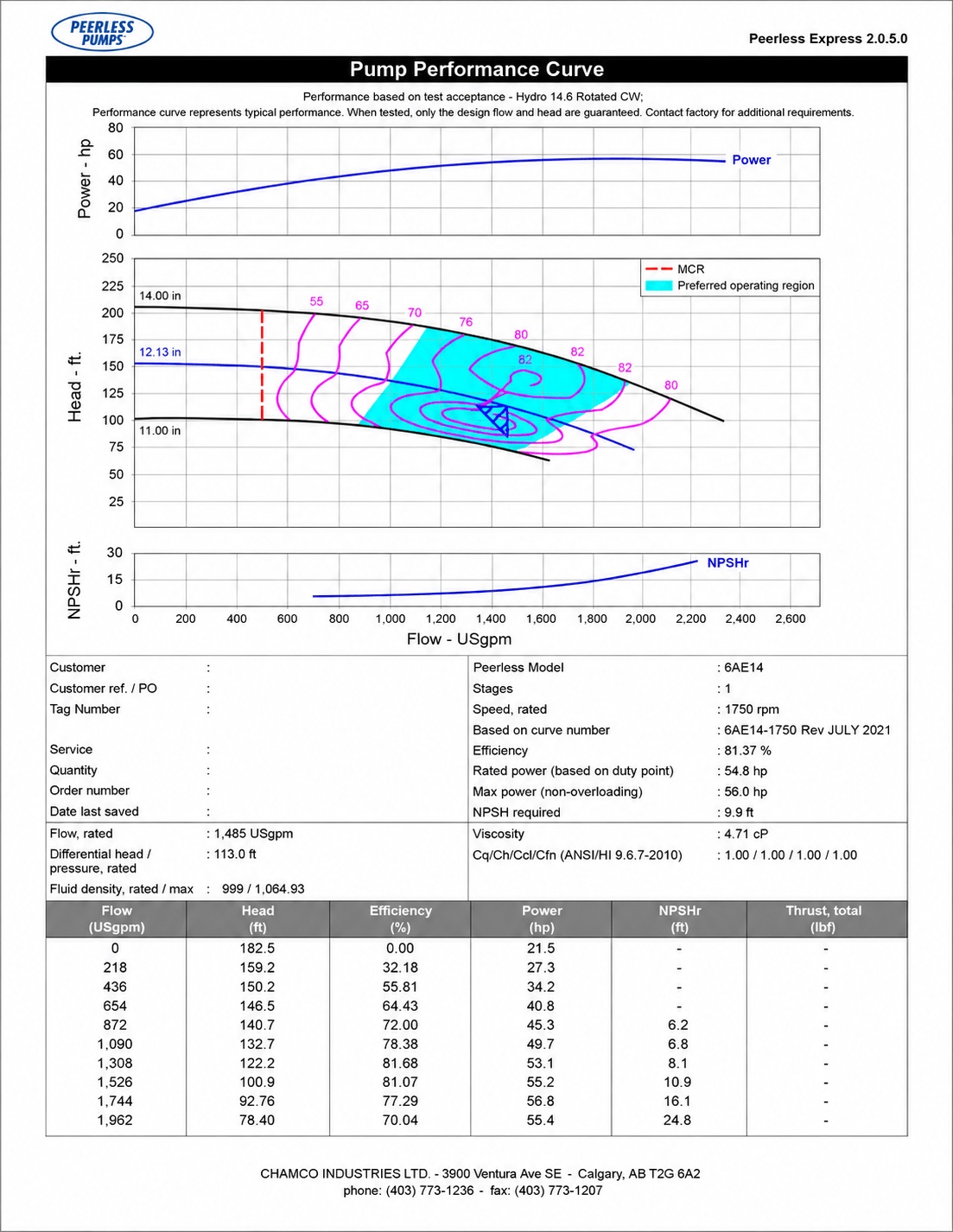
For example, on this a Peerless 6AE14 single-stage selection curve, the duty point sits at 1,465 US gallons per minute and 113 feet of head, marked directly on the sheet as a small triangle on the QH curve. That same point shows the pump running at 81.37% efficiency, requiring 9.9 feet of NPSH, with a 12.13-inch impeller trim within the 10.00 to 14.00-inch range for this casing.
Selection software like Peerless Express automatically prints all of this on one sheet, but that wasn’t always the case. Older curve sheets showed only the bare QH line, efficiency islands, and NPSH curve, and whoever was selecting the pump had to read the duty point off the chart by hand.
What Are Affinity Laws?
Affinity laws are the mathematical rules that describe how a centrifugal pump’s flow, head, and power change as its speed changes. In formula form, using Q for flow, H for head, P for power, and N for speed.
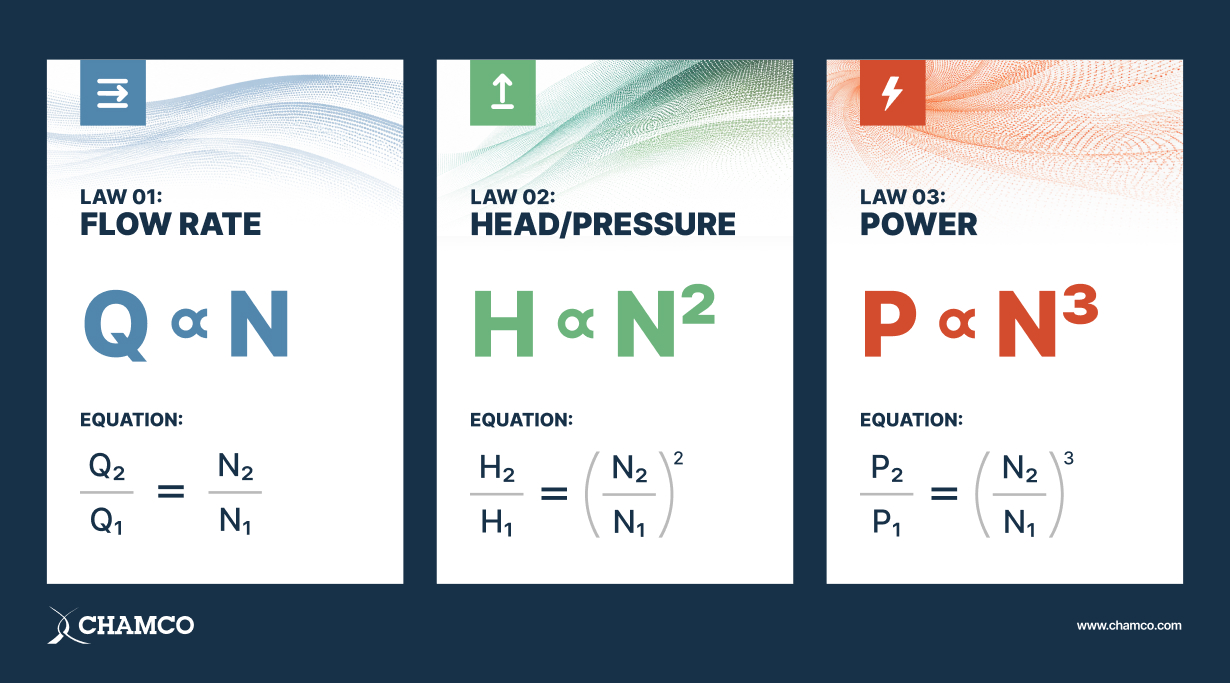
Law 1: Flow Rate
Equation: Q2/Q1 = N2/N1
Double the speed, double the flow. Each revolution of the impeller pushes roughly the same volume of fluid, so the flow scales directly with the number of revolutions per minute.
Law 2: Head/Pressure
Equation: H2/H1 = (N2/N1)²
Double the speed, and the head goes up 4 times (2² = 4), not 2x. Head comes from the velocity the impeller imparts to the fluid, and that velocity is itself proportional to speed. Since the pressure a pump generates is related to velocity squared (basic fluid dynamics), the squaring appears here as well.
Law 3: Power
Equation: P2/P1 = (N2/N1)³.
Double the speed, and the power draw goes up 8 times (2³ = 8). Power is roughly flow × head, and since flow scales with speed and head scales with speed², power scales with speed × speed² = speed³.
At a fixed speed, increasing flow decreases head, and increasing head decreases flow (the same relationship that the QH curve plots directly). Change the pump’s speed, and that whole relationship shifts. Slow the pump down, and the head drops at any given flow rate.
This is also why a single performance curve sometimes shows multiple lines, each one representing the pump’s behaviour at a different speed.
How Do Affinity Laws Affect the Curve?
Affinity laws affect a pump’s overall performance curve. Change the pump’s speed or trim the impeller diameter, and the entire curve shifts, not just the duty point sitting on it.
This matters beyond the math, as some pumps have a QH curve that stays flat as flow increases, while others drop off steeply. A flat curve is harder to control precisely on a variable-speed drive, since a small change in speed produces a comparatively large swing in flow.
What Is Net Positive Suction Head?
Net positive suction head (NPSH) is the difference between the pressure at a pump’s inlet and the lowest pressure inside the pump housing, the point where pressure dips before rising again on the discharge side.
If the inlet pressure is too low, the internal pressure can drop below the pumped fluid’s vapour pressure, causing the fluid to vaporize inside the pump. The vapour bubbles then collapse violently as pressure recovers, a process called cavitation, which causes noise, vibration, and impeller damage over time.
Two numbers describe this in practice:
- NPSH required (NPSHr): the minimum inlet pressure a specific pump needs at a given flow to avoid cavitation.
- NPSH available (NPSHa): the actual pressure your system delivers to the pump’s inlet, accounting for atmospheric pressure and losses like elevation change, pipe friction, and fluid temperature.
Why Do NPSH Numbers Matter?
The single most common pump selection mistake is choosing a pump whose net positive suction head required exceeds the available net positive suction head at the installation.
NPSHr is specific to the pump and is printed directly on its curve, for example, 9.9 feet on a Peerless 6AE14 selection curve.
NPSHa is specific to the installation and must be calculated separately, based on the properties of the pumped fluid, its temperature, and the atmospheric pressure at the site’s altitude.
The rule: NPSH available must always be greater than NPSH required, with the margin sized according to the guidance in Hydraulic Institute standard HI 9.6.1.
Choosing a pump whose NPSHr exceeds the NPSHa actually available results in cavitation.
Frequently Asked Questions
How Do You Read a Grundfos CR Series Curve?
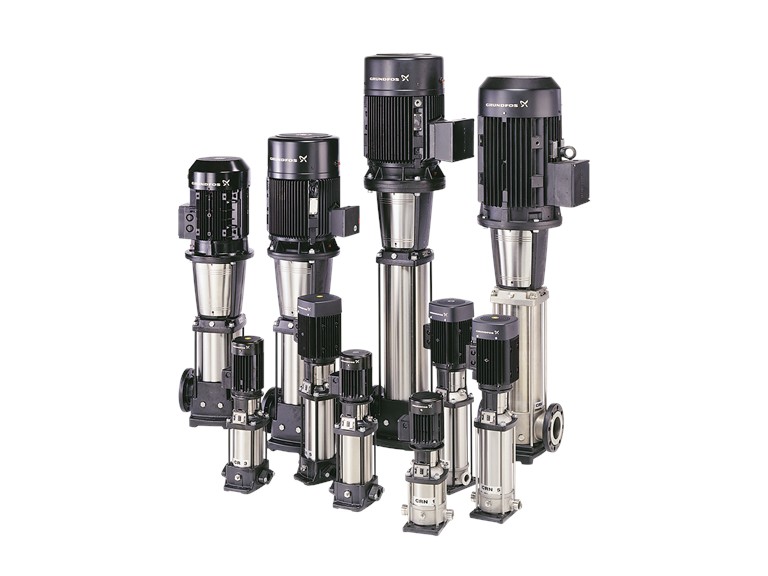
A Grundfos CR series curve is read the same way as any other manufacturer’s curve. The one difference is how a CR pump reaches a given head. Grundfos’s CR line is a vertical multistage design, and multistage pumps build head by connecting stages in series rather than by trimming a single large impeller. So, instead of a family of trimmed-impeller curves, the layout used for single-stage end suction pumps like Peerless’s, a CR curve is typically read per stage count: the more stages stacked in the pump, the higher the head at a given flow.
What Does the Shaded “Preferred Operating Region” Mean?
The preferred operating region on a Peerless 6AE14 selection curve is marked with a cyan band, indicating the zone near the pump’s best-efficiency point. Run a pump too far to the left, at high head but low or non-existent flow, and the pressure inside the pump stresses the impeller and motor bearings. If the flow drops below the pump’s minimum, the fluid can overheat inside the casing. Staying within the shaded band, as close as practicable to the pump’s best-efficiency point, protects the equipment and reduces energy use.
Where Do You Get the Curve for a Specific Pump Model?
Getting a pump performance curve for a specific pump model depends on the manufacturer’s selection software.
- Peerless Express generates the full sheet, curve, and data table together for a specific model, such as a Peerless 6AE14.
- Grundfos uses its own, similar sizing tool across its lineup, including the CR series.
If you don’t have access to that software, or you’re working from an older bare curve with no data table attached, a distributor who carries the brand can pull it for you and walk through what it means for your application.
Chamco Can Help You Read The Curve And Select The Right Pump
Reading a pump curve comes down to four things on one chart, all built around a single duty point:
- Flow and head
- Efficiency
- Power
- NPSH
Getting the duty point right and confirming the available NPSH before purchase can help avoid most pump-sizing mistakes.
Chamco has supplied and serviced industrial pumps across Western Canada for more than 60 years, as the exclusive Western Canadian distributor for Peerless and a distributor for Grundfos and Cornell.
Our specialists regularly review selection curves, checking duty points, NPSH margins, and brand fit before ordering a pump. This guide to choosing the right industrial pump covers the broader pump selection process.
Chamco Pump Schools run hands-on training on reading curves and selecting pumps, on-site or in-house. Contact us to talk through a specific application and find the correct pump.