

Industrial air compressor sizing is the process of selecting a compressor that can reliably deliver the airflow (CFM) and pressure (PSI) required by a facility’s tools, equipment, and production processes. Proper sizing is critical to system performance, energy efficiency, and long-term operating reliability. An undersized compressor can lead to pressure drops, production interruptions, and excessive wear, while an oversized system increases energy consumption and unnecessary operating costs.
This guide explains the key factors that affect industrial air compressor sizing, including CFM demand, PSI requirements, duty cycle, compressor type, and air receiver tank sizing. It also covers common sizing mistakes that can reduce efficiency and shorten equipment life in industrial compressed air systems.
How to Size an Industrial Air Compressor
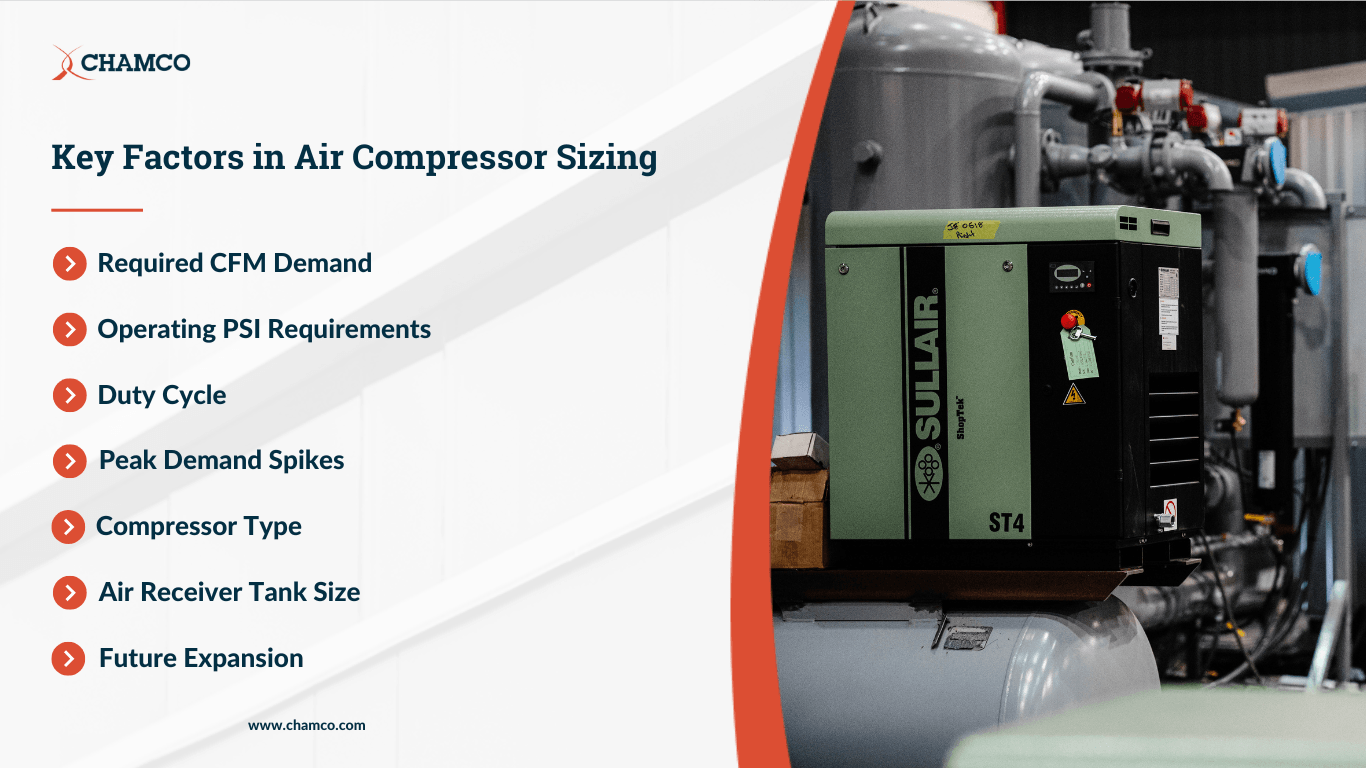
Sizing an industrial air compressor starts with understanding how much compressed air your operation actually requires and how consistently that demand occurs throughout the day. The right compressor must deliver the required airflow and pressure while aligning with the facility’s operating conditions, duty cycle, and future growth plans.
Proper compressor sizing directly affects energy consumption, production uptime, equipment lifespan, and long-term operating costs. An undersized system may struggle to maintain pressure during peak demand, while an oversized compressor can waste significant energy through unnecessary cycling and unloaded operation.
Understand Your Air Demand
Industrial air compressor demand is measured in CFM (cubic feet per minute) and varies based on the tools, equipment, and processes connected to the system. Understanding your facility’s full demand profile, not just the average draw, but peak periods and future requirements, is the foundation of accurate compressor sizing.
This includes:
- The total airflow required across all tools and equipment
- Whether demand is steady or fluctuating
- Peak demand periods during production
- Shift schedules and operating hours
- Future equipment expansion plans
Many industrial facilities experience fluctuating compressed air demand throughout the day. Production lines may start and stop, tools may cycle on intermittently, and certain processes may create short periods of very high airflow demand.
Because of this, compressor sizing should account for both average demand and peak demand conditions rather than relying on a single airflow number.
Facilities that expect future production growth should also include reserve capacity in the original system design to avoid premature equipment replacement or costly system upgrades later.
What PSI Does Your System Need?
Industrial air compressors should be sized to meet the pressure requirements of the equipment being supplied, not solely to the compressor’s maximum pressure rating.
Most industrial applications operate within a relatively standard pressure range, but actual system requirements vary depending on the tools, machinery, automation equipment, and production processes being used.
One of the most important considerations is pressure drop: the loss of pressure that occurs as compressed air travels through piping, filters, dryers, fittings, and other system components. Long piping runs, undersized distribution lines, excessive bends, and restrictive fittings can all reduce usable pressure at the point of use.
If pressure drop is not accounted for during sizing, equipment farther from the compressor may not receive adequate operating pressure during peak demand periods.
Oversizing the system pressure can also unnecessarily increase energy consumption. Industrial compressed air systems should be designed to deliver only the pressure actually required by the application, along with a reasonable allowance for system losses.
Duty Cycle And Compressor Type
Duty cycle is the time a compressor is expected to operate under load during normal operation. Matching the compressor type to the facility’s duty cycle is one of the most important parts of industrial compressor sizing.
Reciprocating Compressors
Reciprocating (piston) compressors are typically better suited for intermittent-duty applications where compressed air demand occurs in shorter operating cycles. These systems are commonly used in smaller shops, maintenance applications, or facilities with lower overall air demand.
Using a reciprocating compressor in a high-demand continuous-duty environment can lead to excessive wear, overheating, and reduced equipment life.
Rotary Screw Compressors
Rotary screw compressors are designed for continuous-duty industrial operation and are commonly used in manufacturing, mining, oil and gas, processing, and other heavy industrial environments.
These compressors are better suited for facilities that require stable compressed air delivery throughout the day because they can operate continuously under load while maintaining more consistent airflow and pressure.
Why Demand Profile Matters
Compressed air demand rarely remains perfectly constant throughout an industrial facility.
Some operations experience:
- Short bursts of very high airflow demand
- Large differences between daytime and nighttime operation
- Seasonal production fluctuations
- Equipment that cycles on and off throughout the day
Understanding these patterns is critical because compressor systems are most efficient when properly matched to the facility’s actual operating profile.
Facilities with highly variable demand often benefit from Variable Speed Drive (VSD) compressors, which automatically adjust output to match changing airflow requirements. This helps reduce energy waste caused by unloaded run time and excessive compressor cycling.
Facilities with stable, continuous demand may instead prioritize fixed-speed rotary screw systems optimized for full-load efficiency.
Oversized vs. Undersized Compressors
Both oversized and undersized compressor systems can create operational problems.
An undersized compressor may struggle to maintain pressure during peak production periods, causing pressure instability, production interruptions, and continuous full-load operation that accelerates wear.
An oversized compressor can also create problems. Industrial compressors operate most efficiently near full load, so oversized systems often spend excessive time unloaded or cycling on and off. This increases energy consumption and operating costs while placing additional stress on system controls and components.
Proper compressor sizing balances airflow demand, operating pressure, system storage, and expected production growth without significantly overbuilding the system.
The Function of Air Receiver Tanks
Air receiver tanks play a critical role in industrial compressed air systems by storing compressed air between the compressor and the distribution network.
Receiver tanks help:
- Buffer short periods of high demand
- Reduce unnecessary compressor cycling
- Stabilize system pressure
- Improve overall operating efficiency
- Assist with moisture separation
As compressed air cools in the receiver tank, moisture condenses and can be removed before it reaches downstream equipment. This helps protect piping, dryers, pneumatic tools, and production equipment from excessive moisture contamination.
Properly sized receiver tanks also improve compressor efficiency by reducing rapid load/unload cycling, particularly in systems with fluctuating demand.
How to Size an Air Receiver Tank
Air receiver tank sizing depends on the compressor output, system demand fluctuations, compressor control strategy, and the type of industrial process being supported. In general, larger tanks provide greater system stability and help reduce compressor cycling during fluctuating demand conditions.
In industrial rotary screw compressor systems, receiver tanks are commonly sized to provide additional storage capacity to absorb temporary demand spikes without causing pressure instability. Systems with highly variable air consumption, long piping runs, or critical production equipment often require larger storage volumes to maintain consistent performance.
Reciprocating compressors typically benefit from larger receiver tanks because they produce pulsating airflow and cycle more frequently. Rotary screw compressors deliver more continuous airflow, but properly sized storage is still important for maintaining stable system pressure and reducing unnecessary load/unload cycling.
The location of the receiver tank within the compressed air system also matters. Many industrial systems use both wet and dry receiver tanks to improve system efficiency and air quality.
Wet vs. Dry Receiver Tanks
A wet receiver tank is installed between the compressor and the air dryer. It receives hot, moisture-laden compressed air directly from the compressor and allows initial cooling and condensate separation before the air enters the dryer. Wet receivers are commonly used to reduce the moisture load placed on downstream drying equipment and to help manage short-term demand fluctuations.
A dry receiver tank is installed after the air dryer and stores clean, dry compressed air for distribution throughout the facility. Dry receivers help stabilize downstream pressure, improve airflow consistency at point-of-use equipment, and protect sensitive industrial processes from pressure fluctuations.
Most industrial compressed air systems benefit from using both a wet and a dry receiver tank. The wet receiver improves moisture management and protects the dryer from sudden demand surges, while the dry receiver maintains stable pressure and consistent airflow across the distribution system. Exercise caution, as too much wet receiver with an insufficient dry receiver can cause the dryer to be overloaded in some applications. Consult with an air systems specialist to ensure your system is properly balanced for your load profile and dryer technology.
Distribution Piping Matters
Compressed air system sizing should always consider the distribution piping network, not just the compressor itself.
Undersized piping, long pipe runs, restrictive fittings, and poor system layout can all increase pressure drop and reduce usable airflow at the point of use.
In many industrial facilities, compressed air performance problems can be caused by limitations within the distribution system.
Proper piping design helps maintain stable pressure, reduce energy losses, and improve overall system reliability.
Redundancy and Future Expansion
Many industrial facilities size compressed air systems with future growth and redundancy in mind.
Adding production equipment, expanding facilities, or increasing automation can significantly increase compressed air demand over time. Building moderate reserve capacity into the system often reduces the need for major compressor upgrades later.
Critical operations may also require redundant compressor capacity to maintain production during maintenance or unexpected equipment failure.
Multi-compressor systems are commonly used in industrial environments because they improve reliability while allowing compressors to stage on and off based on changing demand conditions.
Common Air Compressor Sizing Mistakes
The following sizing mistakes are among the most common causes of inefficient compressor operation and premature equipment failure.
Sizing Only for Current Demand
Many facilities size compressors only for existing production requirements without accounting for future growth, seasonal demand changes, or additional equipment.
Ignoring Pressure Drop
Failing to account for pressure loss across piping and distribution systems can leave downstream equipment without adequate operating pressure during peak demand.
Mismatching Compressor Type to the Application
Using an intermittent-duty compressor in a continuous-duty industrial environment can significantly reduce equipment lifespan and reliability.
Oversizing the Compressor
Installing a compressor that is significantly larger than the actual demand profile can increase unloaded run time, cycling, and energy waste.
Undersizing Air Storage
Insufficient receiver tank capacity can increase compressor cycling, reduce pressure stability, and create unnecessary wear on the system.
Frequently Asked Questions
What CFM do I need for an industrial air compressor?
The required CFM for an industrial air compressor equals the total simultaneous CFM demand of all connected tools and equipment, multiplied by 1.25 to 1.30 to add a capacity buffer. To calculate: list every tool that may run at the same time, add their individual CFM ratings, then multiply the total by at least 1.25. For example, a facility running equipment with a combined 80 CFM demand should specify a compressor rated for a minimum of 100 CFM.
What PSI should an industrial air compressor be rated for?
Most industrial tools and equipment require between 90 and 150 PSI. The compressor should be rated for the highest PSI demand in the system, plus an additional 10 PSI to account for pressure drop across distribution lines. Pressure drop is the loss of pressure between the compressor outlet and the point of use, typically ranging from 5 to 15 PSI, depending on system length, pipe diameter, and number of fittings. If only a small portion of the CFM demand is at a much higher pressure than the majority of the demands, consult with a compressed air specialist on alternative options.
What is the function of an air receiver tank?
An air receiver tank stores compressed air between the compressor and the distribution system. Its three primary functions are: (1) demand buffering, which supplies short bursts of high demand without triggering a compressor cycle; (2) moisture separation, which allows condensed water vapour to collect and drain before reaching downstream equipment; and (3) pressure stabilization, which dampens the pressure pulsations produced by reciprocating and rotary screw compressors.
What is the difference between a wet and dry receiver tank?
A wet receiver tank is installed between the compressor and the air dryer. It receives hot, moist compressed air directly from the compressor and allows initial cooling and condensate separation before the air passes through the dryer. A dry receiver tank is installed after the air dryer and stores clean, dry air for distribution. Most industrial systems benefit from both: the wet tank protects the dryer and compressor from pressure fluctuations during load cycles, removes additional moisture, making the dryer more efficient, and the dry tank protects downstream equipment from pressure fluctuations.
How Chamco Can Help You Size the Right Industrial Air Compressor
Selecting the right industrial air compressor involves more than matching CFM and PSI requirements. Factors such as system demand fluctuations, duty cycle, future expansion, air quality requirements, receiver tank sizing, piping layout, and energy efficiency all impact long-term system performance and operating costs.
Chamco works with industrial and municipal facilities across Western Canada to help evaluate compressed air demand, system performance requirements, and operating conditions to identify the right compressor configuration for each application. As the exclusive Western Canada distributor for Sullair and a supplier of other leading compressor brands, Chamco supplies industrial compressors, compressed air treatment equipment, receiver tanks, and complete engineered compressed air systems for manufacturing, mining, oil and gas, forestry, and other heavy industrial operations.
In addition to equipment supply, Chamco provides system design, installation, preventative maintenance, OEM parts, and service support through six locations across Western Canada.
For help selecting the right industrial air compressor for your facility, contact the compressed air specialists at Chamco.