

Compressor failure rarely happens without warning. The early signs appear long before the compressor completely shuts down.
Even slight shifts in how a compressor runs, whether in temperature, sound, pressure, or oil condition, can signal the start of a larger problem.
What may appear to be a sudden compressor breakdown is often the result of gradual issues that escalate when maintenance routines are neglected, or operational and environmental conditions exceed the equipment’s limits.
Understanding what causes air compressor failure and how to spot problems early can help extend the life of your equipment.
Types of Compressor Failure: Major Breakdowns vs. Operational Interruptions
Not all compressor failures are the same. Some are major breakdowns that require an airend rebuild or full replacement. Others are operational interruptions caused by a single component issue that stops the machine until the fault is corrected.
Major Failures
Major failures typically involve internal airend damage. Once lubrication fails, bearings or rotating groups begin to fail, and damage accelerates quickly, often resulting in a complete rebuild or replacement.
Operational Interuptions
Operational interruptions occur when a compressor won’t start, shuts down unexpectedly, or can’t maintain load due to issues with controls, sensors, electrical supply, or cooling.
These failures can be serious, but are typically repairable once the root cause is identified.
Most major failures begin as minor operational issues that were not addressed early, making timely troubleshooting crucial.
What Is The Most Common Cause Of Major Compressor Failure?
Major compressor failure almost always stems from lubrication failure. High temperatures, dirty or restricted coolers, contamination, low oil levels, or extended service intervals all weaken the lubricant film that protects the bearings and airend.
Once lubrication breaks down, bearing damage accelerates quickly and leads to full compressor failure.
Operational interruptions, electrical faults, sensor issues, or control problems can stop a compressor from running, but they are rarely the cause of major failure.
Why Do Compressors Fail (and What to Look Out For)?
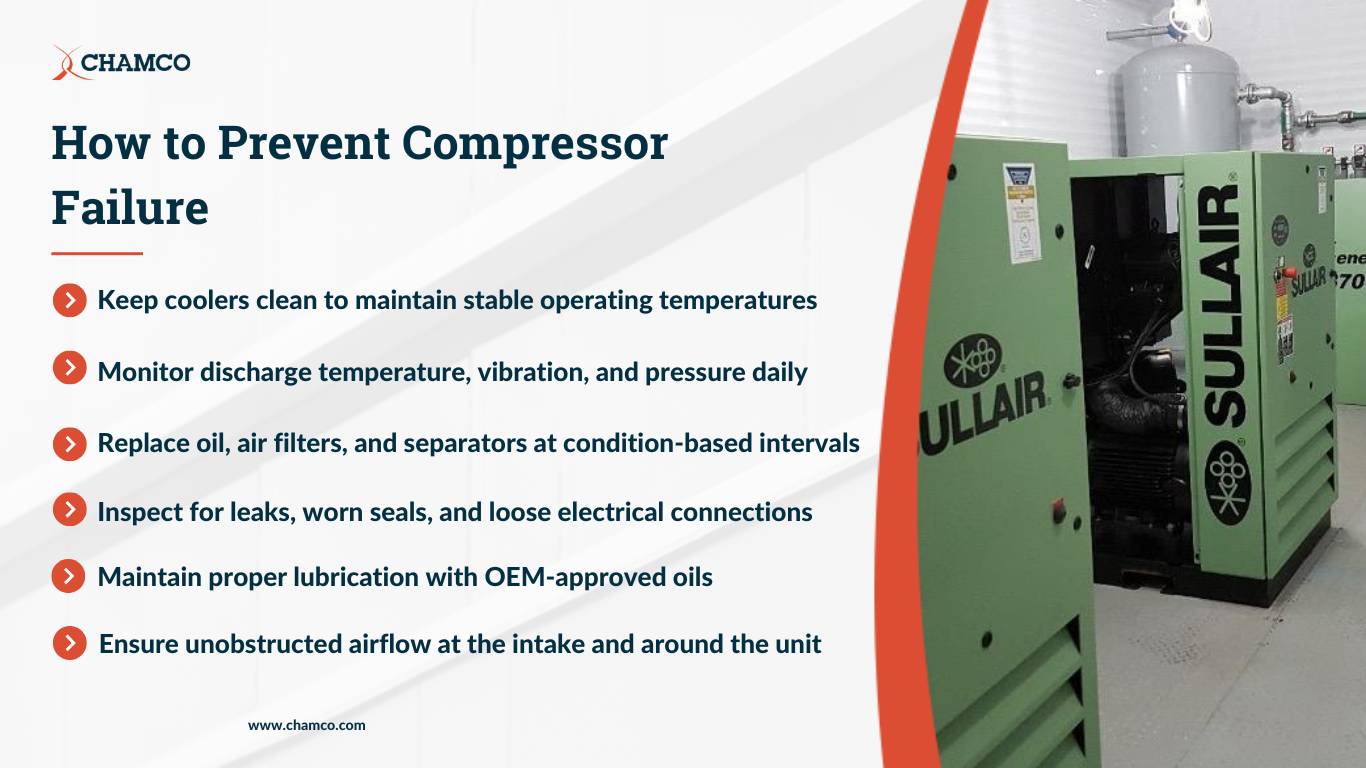
Compressor failures occur when operating conditions exceed the compressor’s design limits, typically involving rising temperatures, restricted cooling, contamination, electrical faults, or maintenance gaps that remain unaddressed.
Here are some of the most common causes and what to look out for:
Overheating
The airend discharge temperature is often the first and most reliable indicator of developing failure. A rising trend may indicate plugged coolers, restricted oil flow, inadequate water cooling, or premature bearing wear within the airend.
Airend discharge temperature should remain between 175°F and 195°F. Anything trending above this range suggests increasing resistance or restricted cooling.
Bearing Failure
Bearings support smooth rotation and load distribution inside the compressor, so any loss of lubrication film, contamination, or misalignment accelerates wear. As the bearing surface deteriorates, friction increases, generating more heat and vibration, which in turn speeds up the failure process.
Electrical Malfunctions
Electrical problems, including voltage imbalance, failing contactors, loose terminals, or undersized wiring, can quickly develop into serious compressor failures. If left unresolved, these problems can lead to motor burnout or nuisance trips that interrupt air supply at critical times.
Inadequate Lubrication
Insufficient lubrication is the underlying cause of many major compressor failures, even when the initial symptom looks unrelated. Using the wrong oil viscosity, running beyond recommended oil-change intervals, or allowing oil levels to drop all weaken the protective film that separates moving parts.
High operating temperatures further reduce oil life, causing it to oxidize and lose effectiveness faster than expected. Once lubrication breaks down, bearings and rotating components are exposed to metal-on-metal contact, rapidly accelerating wear.
Contaminant Infiltration
Dust, moisture, and other contaminants entering the system can damage internal components over time. Contaminants may also bypass filtration if filters are overloaded or not changed frequently enough for the environment. Once inside, they can cause abrasive wear, clog passages, foul coolers, and degrade the quality of lubricant.
Extreme Temperatures
While airend discharge temperature typically remains between 175–195°F, a sudden increase or drop above or below this range indicates the compressor is running too hot or cold.
High heat reduces cooling efficiency, shortens lubricant life, and pushes systems closer to shutdown. Cold conditions thicken oil, strain seals, and can cause condensation or freezing. Cold starts can also restrict oil flow and increase wear if not managed.
Dirty Coolers
Dirty coolers directly contribute to overheating and shorter oil life. When dust, debris, or oil residue accumulates on cooler surfaces, heat transfer is restricted, and the discharge temperature begins to rise. A sudden spike in contaminants can quickly plug a cooler and may require immediate troubleshooting.
Lack of Proper Maintenance
Many compressor failures ultimately trace back to missed or inconsistent maintenance. Skipped inspections, delayed oil changes, ignored alarms, or reliance on untrained personnel all contribute to conditions that accelerate wear and tear.
Preventive Maintenance Tips for Extending Compressor Life
Preventive maintenance should begin by checking the OEM user manual for required service intervals, keeping in mind that these recommendations assume ideal operating conditions. Here are a few other Chamco-recommended preventive maintenance tips to consider:
Monitor Temperature Trends
Rising discharge temperature is one of the earliest indicators of restricted or weak airflow, dirty coolers, inadequate lubrication, or bearing wear. As oil temperature increases, lubricant life shortens significantly, reducing the interval from 8,000 hours to as little as 4,000–6,000 hours.
Look out for overheated motor housings, hot contactors, intermittent trips, or visible discoloration/corrosion inside control panels. Infrared cameras can be used to monitor for abnormal temperature conditions, and are recommended as part of annual maintenance. Infrared cameras help identify loose electrical connections of failing contactor coils.
Listen For Unusual Sounds
New or changing noises, such as rattling, knocking, or grinding, often signal developing mechanical issues and should be checked before running the compressor further.
Keep Cooling Surfaces Clear
Dust, debris, and blocked airflow raise temperatures, weaken lubrication, and force the compressor to work harder. Regular inspection and cleaning help maintain stable operating temperatures.
Verify Oil Level And Condition
Check that the oil level is within the manufacturer’s recommended range; levels that are too low can starve the airend of lubrication, accelerating bearing wear. Beyond the level itself, inspect the oil’s condition.
Discoloured, foamy, or burnt-smelling oil indicates contamination, overheating, or oxidation. Always use OEM-approved lubricants to ensure proper protection.
Inspect And Clean Coolers Regularly
Dust buildup on coolers significantly reduces heat transfer, resulting in increased temperatures and accelerated oil degradation. Look for visible dust on cooler fins, rising airend temperatures, or more frequent high-temperature warnings.
Ensure Proper Ventilation
Poor airflow around the compressor can increase heat and reduce cooling efficiency. Keep the surrounding area clear to support safer operating temperatures.
Follow The Recommended Maintenance Schedule and Use Genuine OEM Parts
Always follow the OEM-recommended maintenance schedule and ensure that qualified, factory-trained technicians complete any troubleshooting or repairs.
Genuine OEM parts maintain proper filtration, cooling efficiency, and lubrication quality. They’re engineered for your compressor model and reduce the risk of premature wear or internal damage caused by incompatible aftermarket components.
How to Decide Whether to Repair, Rebuild, or Replace a Compressor?
The right path, repair, rebuild, or replacement, depends on the severity of the failure and the long-term value of the equipment.
Minor failures can often be repaired quickly if detected early, while more advanced internal wear may necessitate a rebuild to restore performance and extend equipment life.
Full replacement is typically the best option when failures are frequent, efficiency has declined, or equipment damage is severe enough that a rebuild would not deliver a meaningful return on investment.
How Long Do Compressor Failure Repairs Typically Take?
Repair timelines vary widely based on the type of failure. Minor issues like a tripped breaker, loose connection, or clogged filter can sometimes be resolved in minutes. Most operational interruptions fall within a same-day or next-day repair window if parts are available.
Major failures requiring an airend replacement or a new compressor can take two to four months, with factory lead times being the most significant factor. Custom builds, backorders, shipping, and commissioning all add to the timeline.
How Much Does an Unexpected Compressor Repair Cost?
At Chamco, we’ve seen repair costs vary widely depending on the type of failure and the duration of the issue. Minor issues, such as a plugged control line or a simple electrical fault, can cost as little as $100 when caught early, especially if technicians are already onsite for other service work.
Unexpected failures caused by severe contamination, collapsed filters, burst coolers, or significant component damage can reach $50,000 or more, particularly if the breakdown occurs during extreme weather or outside regular hours.
Because failures take so many forms, emergency repairs are almost always more expensive than routine maintenance. The actual cost depends on the root cause and the timing of the failure.
How Chamco’s Preventive Maintenance Programs Prevent Compressor Failure
Chamco’s preventive maintenance programs reduce unplanned failures by focusing on real operating conditions, not ideal assumptions. Condition-based inspections, vibration monitoring, oil analysis, cooler evaluation, and control verification help detect issues early, before they turn into costly downtime.
Service intervals are adjusted based on temperature, dust load, runtime hours, and environmental stress, ensuring cooling paths stay clear, lubrication remains stable, and components operate within safe limits.
With structured, condition-based planning, compressors stay within safe operating ranges more consistently, resulting in fewer failures, lower lifecycle costs, and more predictable operation throughout the year.
Unlock Long-Term Compressor Reliability With Chamco
With factory-trained technicians, OEM-approved components, and condition-based inspections, Chamco helps facilities maintain stable performance and avoid costly downtime. Our proactive approach keeps compressors running reliably throughout the year.
Across Western Canada, organizations that prioritize proactive care see lower lifecycle costs, fewer disruptions, and more predictable operations.
Speak to an air compressor expert for support in diagnosing compressor issues or to set up a preventive maintenance schedule today.